

Reflections on My Technical Writing Journey: A Year in Review
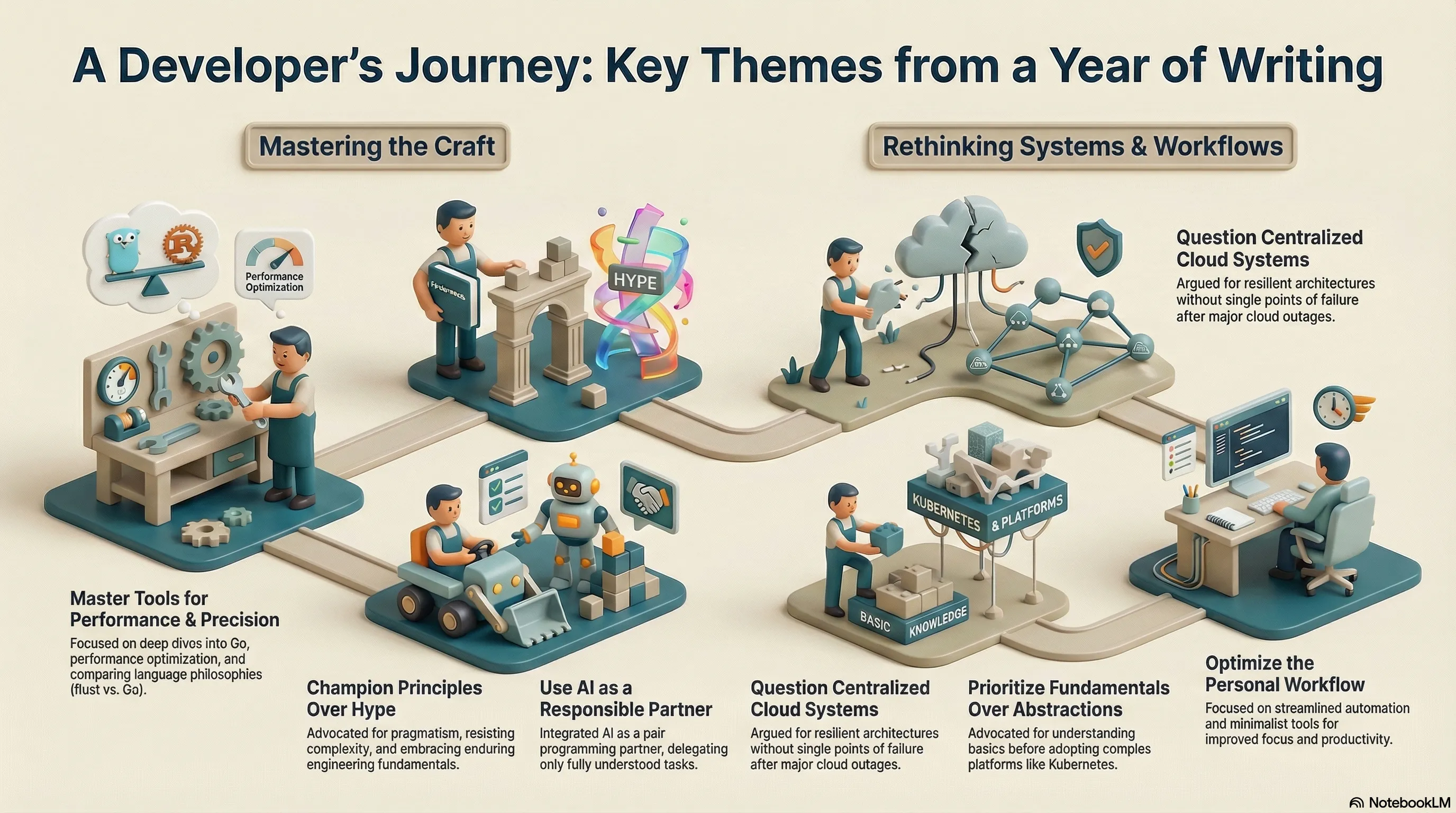
Before diving in, I want to be fully transparent: this summary article was generated by AI, based on my past writings. While I’m deeply committed to writing all my content authentically—without AI assistance—this retrospective is an exception, a tool to help consolidate twelve months of thoughts into a cohesive reflection. Now, let’s look back at the themes, ideas, and lessons that have shaped my journey so far.
Deepening the Craft: Performance and Precision
The latter half of the year saw a continued focus on mastering tools and squeezing out performance, particularly with Go. Articles like Optimizing Go Memory Management for Performance and PGO in Go: Optimizing AOT Code Like JIT moved beyond syntax to explore how the compiler and runtime behave under pressure. This technical deep dive extended to the boundary between Go and C in CGo vs. Purego: Integrating C with Go and the nuances of concurrency in Mastering Go’s Concurrency: Goroutines and Channels. The goal was always clarity: understanding the fundamentals to make informed decisions, whether about function splitting and performance or memory pools.
This period also featured a thoughtful comparison of language philosophies. In Rust’s Flexibility vs. Go’s Simplicity and Revisiting Technology Choices in Modern Development, I examined the trade-offs between expressive power and enforced simplicity. This exploration also led to a reassessment of other paradigms, sparking thoughts on Rethinking C++ in an Era of Go, Rust, and Zig. The conclusion wasn’t about declaring a winner, but about matching the tool’s ethos to the problem—and the team—at hand, a theme further explored in Generics in Go: Tradeoffs and Alternatives.
Rethinking Infrastructure and Resilience
A major theme emerged from real-world events: questioning our over-reliance on centralized systems. The widespread AWS disruption in October 2025 directly inspired Beyond the Cloud Hype: Building Resilient Systems, arguing that true robustness requires architectures without single points of failure. This connected to earlier thoughts on internet dependency in Beyond Internet Dependency: Designing for Resilience and was framed within the larger concept of Digital Sovereignty Beyond the Buzzwords.
This critique naturally extended to the container and orchestration ecosystem. In Containers, Kubernetes, and the Value of Understanding Basics and Beyond Kubernetes: Choosing the Right Infrastructure Abstraction, I advocated for understanding the fundamentals (namespaces, cgroups) before adopting complex platforms, promoting simpler, more transparent solutions where appropriate. This exploration even looked to the future with WASI: The Lightweight Challenger to Server Containers, examining WebAssembly’s potential to redefine how we package and run code.
The Evolving Developer Workflow
My own development environment and habits remained a rich source of reflection. I documented the shift to streamlined automation in From Makefiles to Bun: Modern Task Automation Tools and shared a controversial but deeply felt opinion in Why a Single Monitor Boosts Focus and Productivity, advocating for minimalism in our physical workspaces as we do in our code. This focus on practical setup extended to explaining Why I Choose Windows for Software Development and solidifying Why Bun Has Become My Go-To JavaScript Runtime.
The most significant evolution, however, was in integrating AI into the creative process. Moving beyond using it as a code generator, I outlined a partnership model in Using AI as a Pair Programming Partner in Development, establishing the rule of only delegating tasks I fully understand. This responsible collaboration was applied practically in projects like Efficient Web Workers with Bun and CBOR Serialization. This experiment began with the website’s own creation, as shared in My GenAI Experiment: Building a Website with Authentic Content and AI Support, and matured into a broader perspective on AI in Software Development: Tool, Not Replacement.
Principles Over Hype: Sustaining Software Craft
Throughout, a strong undercurrent was a call back to enduring engineering principles. Reclaiming Pragmatism in Software Development sought to rescue the term from being a synonym for cutting corners, defining it instead as the mindful application of deep understanding. Avoiding Over-engineering and Unnecessary Dependencies provided a practical guide to resisting complexity creep, while Why Extreme Programming Matters More Than Ever argued that the industry had forgotten the crucial engineering practices behind Agile.
These principles were applied to the full development lifecycle. Container-Driven Development: Beyond Production, Into Your Workflow showed how to use containers for robust local development, and Why the Cloud Isn’t a Backup Solution served as a crucial reminder about foundational operational hygiene. The craftsmanship theme was further explored in Building Software Like a Master Craftsman and a critical look at The Pitfalls of Low-Hanging Fruits in Software Development. Collaboration was highlighted as a key pillar in The Power of Code Reviews: Building Better Software and Stronger Teams.
The Web Platform: Simplification and Standards
My advocacy for the web as a universal platform continued, but with a refined focus on shedding unnecessary abstractions. Building Modern Web Apps Without Heavy Frameworks laid out a blueprint leveraging modern native APIs and Web Components. This practical experience led to a critical evaluation in Lit vs Svelte: Rethinking Web Component Development, questioning when a full framework is truly needed versus a leaner, precompiled approach. The journey with web standards involved Balancing DX and Web Standards: My Experience with Astro and Lit and culminated in a realistic assessment of current limitations in Why PWAs Still Lag Behind Native Apps in 2026. Yet, the foundational belief remained strong, as argued in Why Web Technologies Still Win for Cross-Platform GUI Development.
Fundamentals, Philosophy, and the Big Picture
Underpinning the technical discourse were meta-reflections on the craft itself. Articles like The Evolution of Computer Science: From Mysticism to Pragmatism and The Two Faces of Abstraction: Power vs. Hidden Dependency stepped back to examine the philosophical and structural forces shaping our work.
Looking Forward
This year has been a journey from the micro—optimizing a Go memory pool—to the macro—designing systems for a resilient digital future. The constant has been a pragmatic curiosity: a willingness to dive deep into how things work, coupled with the judgment to know when complexity serves a purpose and when it is merely a distraction.
As I move forward, the themes of sovereignty, simplicity, and sustainable craftsmanship seem more relevant than ever. The tools will keep changing, but the core challenges of building reliable, understandable, and valuable software remain. Thank you for being part of this exploration.
—Written by AI, with gratitude for the human behind the words.