

Beyond the Tool Trap:
Rediscovering Real Innovation
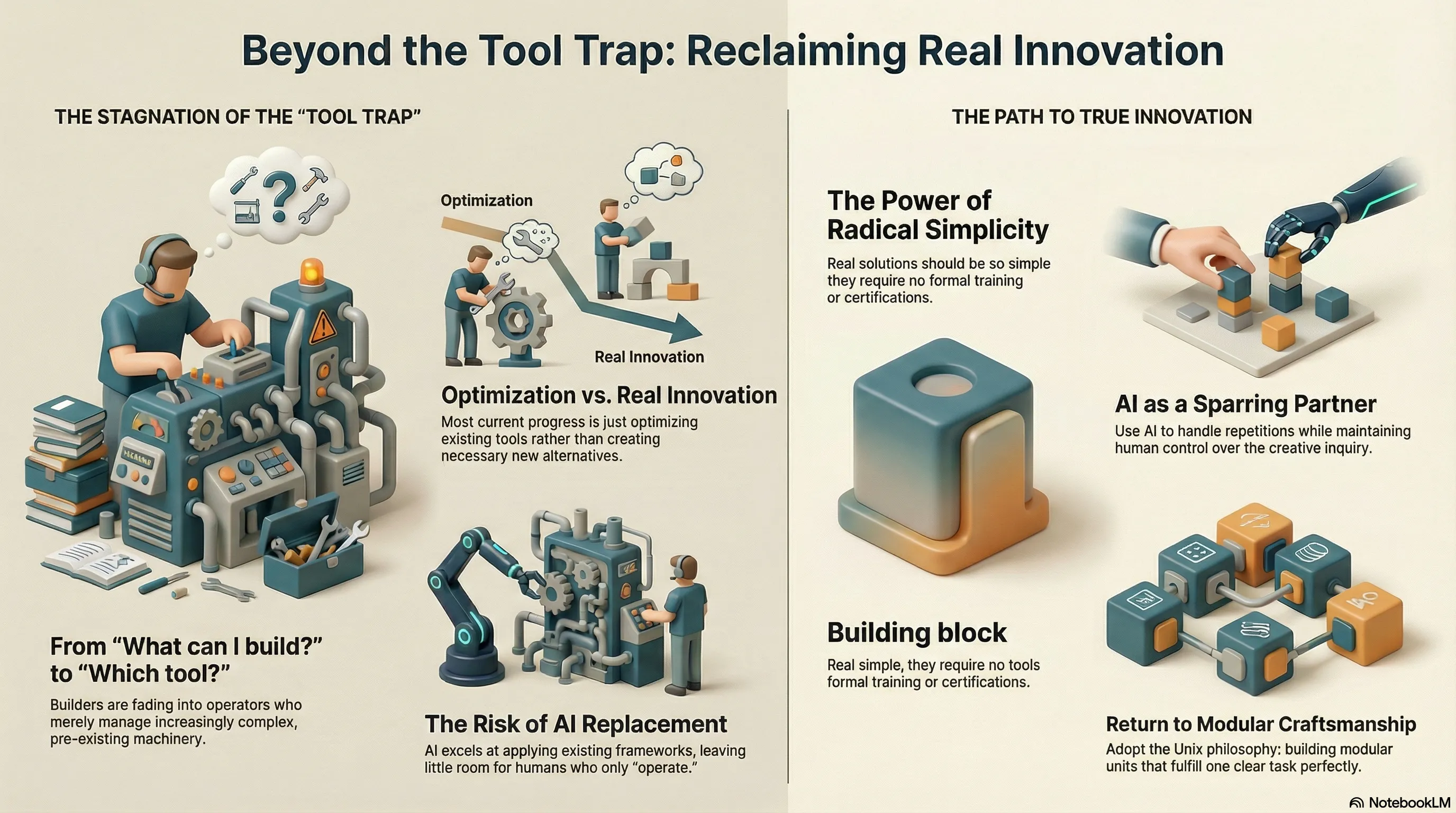
I like simplicity. I like clarity. I like unequivocalness. All of these things are being forgotten in the complex world of ever-growing tool landscapes. These qualities are often not taken seriously; they supposedly lack power, flexibility, or adaptability. But the exact opposite is true, if you know how to use such tools. The essence of the Linux philosophy is based on this aspect. The same goes for the most important software paradigms, which aim for modular units to fulfill a clear task.
The Trap of High-Level Tools
In fact, I continue to observe that—at least in my professional environment—many software engineers are primarily users of high-level tools. Whether frameworks, libraries, automation tools, or infrastructure: they adapt their work to a seemingly necessary environment. The aspect of developing something of your own isn’t even part of the discussion anymore. It’s often just swapping one tool for another.
Losing the Spirit of Inquiry
In my eyes, a great deal of the “spirit of inquiry” gets lost here. It feels like people are just waiting for “someone else” to come along with the next big thing. But then you shouldn’t be surprised if you feel pressured by AI. Applying existing things is something AI can do wonderfully. However, driving real innovation forward is still the strength of humans, who should view AI as a tool.
AI as a Partner, Not a Replacement
I really enjoy working with AI. I see it as a sparring partner—one that regularly exhausts me, admittedly, with pointless repetitions or the remark that “this is just how it’s done nowadays”—but compared to countless web searches, it’s a very pleasant way to work. Used correctly: an enormous relief.
Innovation or Stagnation?
But I’m increasingly reading articles about how “AI-TOOL X” has created the umpteenth improved, more secure, or more powerful version of “EXISTING TOOL Y” in “PROGRAMMING LANGUAGE Z.” People are apparently so trapped in the tool world that they merely try to optimize what already exists.
Fundamentally legitimate, yet it still describes a certain stagnation. Where is the real innovation? The tools that will captivate us anew don’t exist yet. Especially in the cloud environment and with distributed systems—my daily workplace—there WILL have to be something that we don’t have today. Not least because we need alternatives, since the complexity and costs have long ceased to be fun.
The Need for True Simplicity
Some are consciously taking a step back. And that’s the right thing to do! It provides full control and transparency. I am convinced that there is a gap here, the answer to which hasn’t been formulated yet. One thing is clear to me, at least: such a solution will have to be so simple that it wouldn’t even be worth offering training or certifications for it.
Further Reading
On Simplicity & Fundamentals
- The Unix Philosophy – A fundamental look at why “doing one thing and doing it well” is the bedrock of robust systems.
- Simple Made Easy – Rich Hickey’s classic talk on the vital distinction between “simple” (objective) and “easy” (familiar).
- A Philosophy of Software Design – John Ousterhout’s approach to reducing complexity through deep modules.
On the Cloud Complexity Crisis
- Is the Cloud Broken? Rethinking Simplicity – An analysis of how rapid cloud evolution introduced “innovation excess” and hidden costs.
- Alternative Cloud: Why we need different approaches – Explores why the “hyperscaler” model doesn’t fit every use case and the rise of specialized providers.
- Cloud Cost Management as a Design Discipline – Discusses the shift from “cloud as a place” to a unified operating model focused on data locality and sustainable costs.
- The 8 Fallacies of Distributed Computing (2026 Edition) – Why the core challenges of distributed systems remain relevant despite (or because of) modern tooling.