




Final Reflection
For me, StayAwake is a complete success. It has become a tool that accompanies me daily without me even noticing it. It’s specialized, absolutely transparent, and solves exactly the defined scope for which it was designed.
Lessons Learned
The journey through development has also taught me important lessons about the current state of technology:
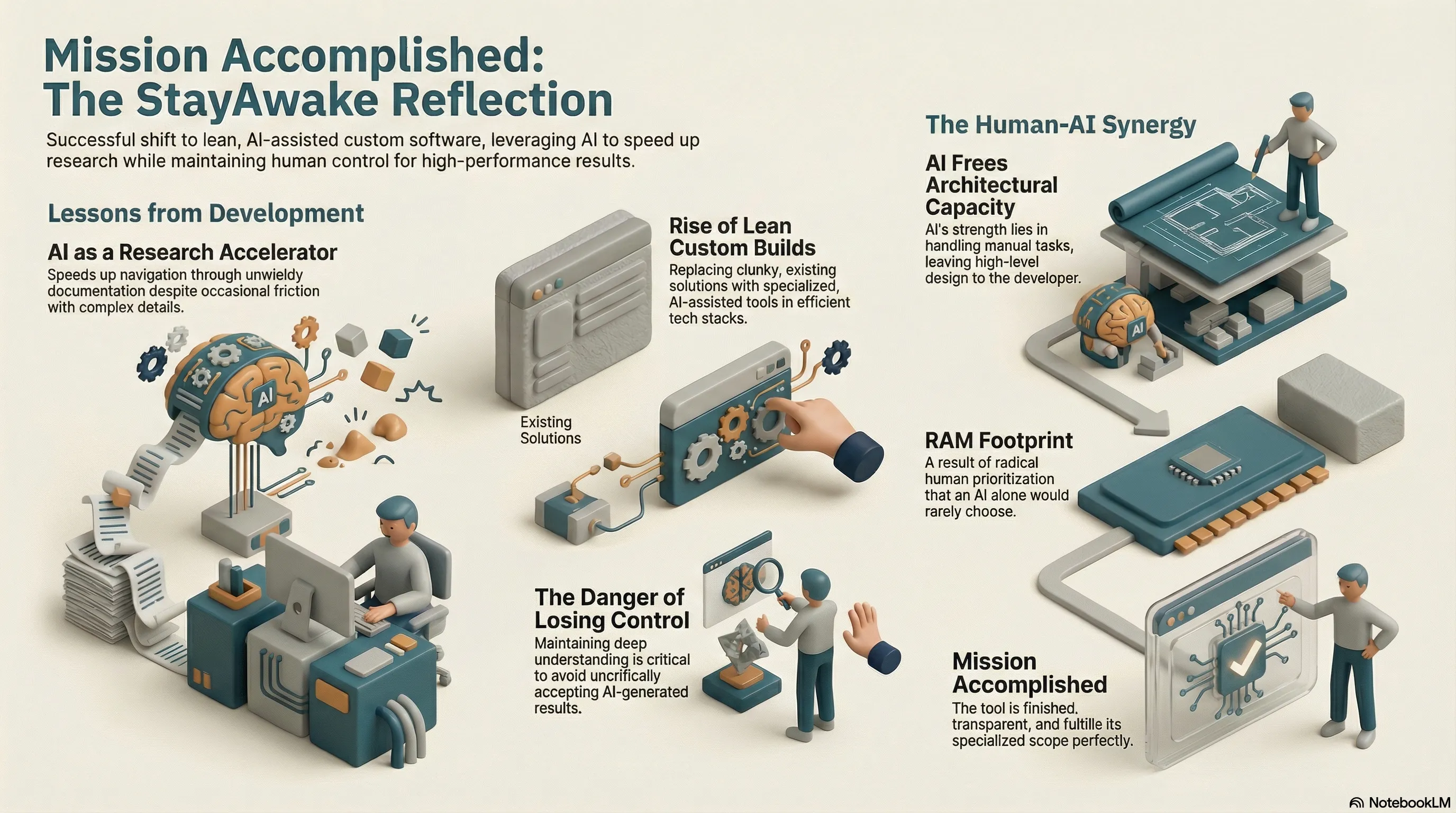
- The Role of AI: Interacting with Gemini wasn’t always frictionless. It’s astonishing how easily these tools can “get lost” in complex details. Nevertheless, AI remains an enormous help, massively speeding up manual research in the often unwieldy Win32 documentation.
- Tailored Solutions: The path to one’s own specialized tool is now easier than ever. This explains the trend of replacing existing, often “clunky” solutions with lean, AI-assisted custom builds in safer or more efficient tech stacks.
- The Danger of Losing Control: With the easy availability of code comes the increased risk of uncritically accepting results. For me, this project was therefore also an exercise in maintaining control and truly understanding every detail of the implementation.
What’s Next
StayAwake in its current form is “finished” and diligently does its job. Nevertheless, the spirit of discovery remains alive: at some point, I will review the structure again to optimize any inconsistencies and further question the binary size. But for the moment, the verdict stands: Mission accomplished.
The StayAwake project impressively demonstrates that the true strength of AI lies not in replacing the developer, but in freeing up their capacity for architectural decisions. Critically questioning the AI and understanding the code as one’s own work is the decisive factor in the quality of the result. A 1.4 MB RAM footprint is the outcome of human prioritization—a radical choice an AI alone would rarely make.